Gravel Calculator

Gravel Calculator

Calculate the amount of gravel or aggregate needed in tons and cubic yards by entering the dimensions below. Estimate material given the length/width/depth, the area, or the volume of material needed.

  • By
    FindPros

    FindPros connects consumers with professionals in over 600 different categories.

  • Reviewed by
    Jacky L.

    FindPros connects consumers with professionals in over 600 different categories.

Calculate Material Using Project Dimensions

This field is required.
Value should be positive.
This field is required.
Value should be positive.
This field is required.
Value should be positive.

Optionally enter the price per ton or cubic yard

$
Please enter valid price.

Calculate Material Using Area and Depth

This field is required.
Value should be positive.
This field is required.
Value should be positive.

Find area Using our square footage calculator

Optionally enter the price per ton or cubic yard

$
Please enter valid price.

Calculate Material Using Volume

This field is required.
Value should be positive.

Find volume Using our cubic yards calculator

Optionally enter the price per ton or cubic yard

$
Please enter valid price.
Results:
{{tons_min}} – {{tons_max}}
{{cubic_yards}}

Cost:

{{cost}}

Learn how we calculated this below

Add this calculator to your site

How to Estimate How Much Gravel You Need

Gravel and other landscaping material are often sold either by the ton or the cubic yard. While this varies by supplier, many sell large volumes by weight in tons.

Therefore, to know how much material you will need to order, you will need to start with getting the weight of the material you need.

To find the weight of material in tons, you’ll need to know the approximate density of the material. Fortunately, there are some common densities that you can use for these calculations. See the chart below to see how many tons are in a cubic yard of gravel.
Step One: Calculate Volume in Yards

In addition to the weight of the material, you also need to know the volume of the space you are filling. Both weight per cubic yard and the total volume are necessary to determine how many tons you will need to order. Therefore, the first step to estimating how much gravel, sand, or soil you need is to estimate the volume of material needed.

Start by measuring the length, width, and depth of the area you need to fill in the same unit of measurement.

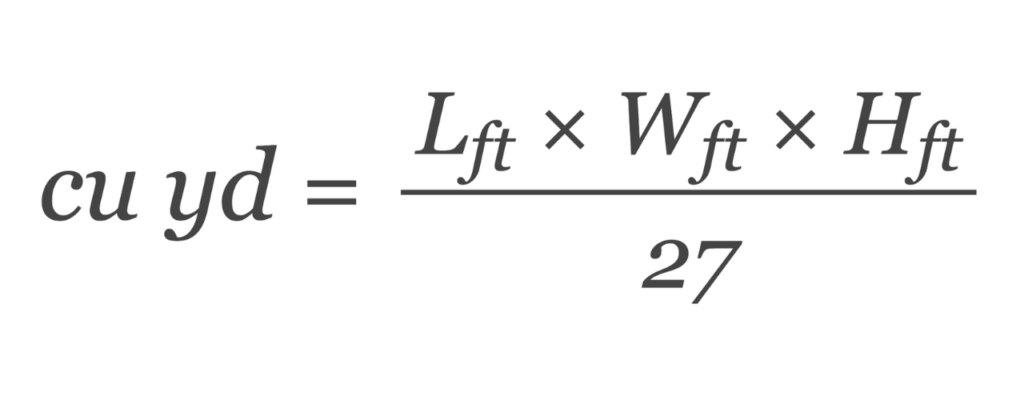
Multiply the length, width, and height together to find the volume of the space. If you measured in inches, then what you have is the volume needed in cubic inches, and if you measured in feet, then you have your total cubic feet.

Next, convert the volume to cubic yards.

If the initial measurements were in inches, then convert cubic inches to cubic yards by dividing the total number of cubic inches by 46,656. If the initial measurements were in feet, then divide the total number of cubic feet by 27 to get cubic yards.
As a shortcut, try our cubic yardage calculator to conveniently calculate your volume.

Step Two: Calculate Gravel Weight in Tons

Armed with the volume of material needed in cubic yards, the weight of material in tons can be found by multiplying the volume by the material density. Most gravel weighs 1.4 to 1.7 tons per cubic yard. See below for more common material densities

For example, let’s find the amount of gravel needed for a space that is 10 feet long, 10 feet wide, and 1 foot deep.

volume = length × width × depth
volume = 10′ × 10′ × 1′ = 100 cu ft
cu yds = 100 cu ft / 27 = 3.7

weight = cu yds × density
weight min = 3.7 × 1.4 = 5.2 tons
weight max = 3.7 × 1.7 = 6.3 tons

How Many Tons in a Yard of Gravel

The chart below shows how many tons are in a yard of gravel, rock, sand, soil, and other landscaping materials.

Material Weight per Cubic Yard Weight per Cubic Meter
Pounds Tons Kilograms Metric Tons
Gravel (¼” – 2″) 2,800 – 3,400 lbs 1.4 – 1.7 tons 1,660 – 2,020 kg 1.66 – 2.02 tonnes
Rock (2″ – 6″) 3,000 – 3,400 lbs 1.5 – 1.7 tons 1,780 – 2,020 kg 1.78 – 2.02 tonnes
Sand (wet) 3,000 – 3,400 lbs 1.5 – 1.7 tons 1,780 – 2,020 kg 1.78 – 2.02 tonnes
Sand (dry) 2,600 – 3,000 lbs 1.3 – 1.5 tons 1,540 – 1,780 kg 1.54 – 1.78 tonnes
Topsoil (wet) 3,000 – 3,400 lbs 1.5 – 1.7 tons 1,780 – 2,020 kg 1.78 – 2.02 tonnes
Topsoil (dry) 2,000 – 2,600 lbs 1 – 1.3 tons 1,190 – 1,540 kg 1.19 – 1.54 tonnes
Riprap 3,400 – 4,000 lbs 1.7 – 2 tons 2,020 – 2,370 kg 2.02 – 2.37 tonnes

Weight per cubic yard and cubic meter of gravel and other common landscape material

How Many Yards in a Ton of Gravel

The chart below shows how many yards are in a ton of gravel, rock, sand, and soil.

Material Cubic Yards per Ton
Gravel (¼” – 2″) 0.59 – 0.71 cu yd
Rock (2″ – 6″) 0.59 – 0.67 cu yd
Sand (wet) 0.59 – 0.67 cu yd
Sand (dry) 0.67 – 0.77 cu yd
Topsoil (wet) 0.59 – 0.67 cu yd
Topsoil (dry) 0.77 – 1 cu yd
Riprap 0.5 – 0.67 yds

Table showing how many yards per ton of gravel, rock, soil, and sand.

Check out our stone and mulch calculators for estimating other landscape materials.

How to Account for Overage and Compaction

In most instances, it’s a good idea to factor in additional gravel or overage when calculating what you need. For example, some gravel may be lost when you transport it to the final site. It may slip off your wheelbarrow or spill from the back of the truck prematurely.

In addition, if you are backfilling an area with gravel, there may be voids that you have not accounted for, which will increase the amount of gravel needed to complete the job. To account for these, it’s generally a good idea to order an additional 10%.

For example, if your calculations call for 5.2 tons of gravel, you will want to purchase 5.7 tons to account for necessary overage.

Gravel is also sometimes compacted prior to other materials being placed on top of it. This compacting can lose as much as 20% of the total volume you wanted to fill. Therefore, after accounting for overage, you will need an additional 20% of material to account for the volume lost during compacting.

In the above example, 5.7 tons is necessary to include overage, but to account for compacting, you would need roughly 6.8 tons to make up the lost volume. Keep in mind that not all gravel needs to be compacted, and some varieties compact more than others, so this much additional material will not always be required for every project.

Frequently Asked Questions

This will largely depend on how much gravel you need and the supplier you are purchasing it from. Most suppliers sell gravel by the ton, but some may sell it by the yard, particularly if you only need a small amount.

This will vary depending on the size of the gravel, which can range from ½” to 2″ in size. A ton of gravel will generally cover between 0.59 to 0.71 cubic yards, with larger-sized gravel covering less area than smaller-sized gravel.

Trucks come in many sizes and can handle various amounts of weight. The average pickup truck can carry 1 cubic yard of gravel, while a dump truck can carry 13 to 25 tons of gravel.

At a cost of $35 to $50 per ton, a full dump truck load could cost anywhere from $455 to $1,250.
Grass Seed Calculator

Grass Seed Calculator

  • By
    FindPros

    FindPros connects consumers with professionals in over 600 different categories.

  • Reviewed by
    Jacky L.

    FindPros connects consumers with professionals in over 600 different categories.

Lawn Size:

This field is required.
Value should be positive.
This field is required.
Value should be positive.

Project Type:

  • This field is required.
This field is required.
Value should be positive.

Find square feet or acres

Project Type:

  • This field is required.
Seed Needed:
{{weight}}
{{weight_kg}}
{{weight_per_1k_sqft}}
{{weight_per_1kg_sqm}}

Total Area

{{total_area_sqft}}
{{total_area_sqm}}
{{total_area_acres}}
{{total_area_hectares}}

Learn how we calculated this below

Add this calculator to your site

(Re) Seeding Grass – How Much Seed Do I Need?

When creating a lawn, there are basically two options, either lay sod (pre-grown grass that comes in squares or rolls) or plant grass from seed. There are advantages to each method.

Laying sod provides an instant lawn that can be installed in nearly any season, quickly eliminating muddy, unattractive yards. Sod is fast to lay down and is available in several varieties.

All this convenience comes with a substantial price tag, though. Installing fresh sod can cost thousands of dollars. If you are considering this option, try our sod calculator to figure an estimate for your project.

Grass seed is a cost-effective alternative to sod and offers a few other advantages as well. There are many more varieties of seed available than varieties of sod.

And, planting seed allows the grass to establish itself directly in the environment in which it will live.

The drawback, of course, is that seed takes time to grow and must be planted at the proper time of year to be successful. This can mean a long wait until you have grass to mow.

Grass seed makes up for it in cost savings, though, and is the best alternative for filling in bare spots in existing lawns.

Grass Varieties and Quantity

Lawn grasses are usually classified into either warm-season or cool-season grasses. The different varieties offer different textures, hardiness, and drought tolerance. They also require different amounts of seed to grow into lush lawns.
Warm-season grasses grow better in warmer climates, including the southern US. Bermuda, St. Augustine, and Zoysia are warm-season grasses.

Cool-season grasses thrive in cooler temperatures or climates with temperature fluctuations. Fescues, Kentucky Bluegrass, and Ryegrass are beautiful cool-season varieties.

Besides variety, how much grass seed you use also depends on whether you are growing a lawn from bare soil or over-seeding an existing one. New lawns generally require about twice as much seed as overseeding.

Most seed suppliers indicate coverage rates in pounds of grass seed per 1,000 square feet of land covered. Your supplier will know the coverage rate for the variety you’re purchasing, or see the table below for recommended coverage rates for common varieties.

Grass Seed Coverage Rates

Grass seed coverage rates for common grass varieties.

Variety New Lawn Coverage
in Pounds of Seed per 1,000ft2
Overseeding Coverage
in Pounds of Seed per 1,000ft2
Bahia 10lbs per 1,000ft2 5lbs per 1,000ft2
Bermuda 2lbs per 1,000ft2 1lb per 1,000ft2
Buffalo 3lbs per 1,000ft2 1.5lbs per 1,000ft2
Centipede .5lbs per 1,000ft2 .3lbs per 1,000ft2
Creeping Red Fescue 5lbs per 1,000ft2 2.5lbs per 1,000ft2
Fine Fescue 5lbs per 1,000ft2 2.5lbs per 1,000ft2
Kentucky Blue Grass 4lbs per 1,000ft2 2lbs per 1,000ft2
Perennial Ryegrass 10lbs per 1,000ft2 5lbs per 1,000ft2
St. Augustine 2lbs per 1,000ft2 1lb per 1,000ft2
Sun & Shade Mix 6lbs per 1,000ft2 3lbs per 1,000ft2
Tall Fescue 10lbs per 1,000ft2 5lbs per 1,000ft2
Zoysia 2lbs per 1,000ft2 1lb per 1,000ft2

Calculating Seed Quantities for Your Property

If you are using the calculator above, you can skip this section and get right seeding your lawn! Try our lawn mowing calculator to estimate how long it will take to mow your new lawn.
If you want to calculate by hand, read on!

To calculate the total quantity of grass seed you will require, you will need to know the type of grass you want and the size of the area you’re planting. Since most coverage rates are given per 1,000 square feet (or square meters), you will need to end up with those units.
Here’s how:

  • If your area is smaller, simply measure it in feet or meters. Then multiply the sides together. Done!
  • If you already know the acreage size, you can convert acres to square feet using our acres to square feet conversion calculator. Or, multiply the number of acres by 43,560 sq. ft.
  • If you are unsure of the acreage, use our map-based acreage calculator to find out.
  • After you’ve found your square footage, divide it by 1,000.

All that’s left to do is multiply your area (in 1,000’s of sq. ft.) by the amount of grass seed recommended for your grass type. Now you have the total number of pounds of seed needed.

Take the total number of pounds to your supplier and pick out your seed. Grass seed is usually sold by the bag (10lbs, 20lbs, and 50lbs), so you can use your result to figure out how many bags you need.

Example Grass Seed Calculation:

Suppose you have a new yard that is 0.23 acres that you want to plant Sun & Shade Mix.

Calculate Square Feet

0.23 acres × 43,560 sq. ft = 10,018.8 sq. ft.
10,018.8 sq. ft. ÷ 1,000 = 10.02 thousand sq. ft.

Calculate Grass Seed Quantity

From the table above, Sun & Shade Mix requires 6 lbs. of seed per thousand sq. ft. for a new planting.

10.02 thousand sq. ft. × 6 lbs. = 60.11 lbs. of grass seed required

One 50 lbs. + one 10 lbs. bag will be sufficient for your project.

Enjoy your new lawn!

Recommended Landscaping Resources

Elevation Grade Calculator

Elevation Grade Calculator

Calculate the grade of an elevation in degrees or grade percentage and estimate the horizontal or vertical distance needed to support an incline to an elevation.

  • By
    FindPros

    FindPros connects consumers with professionals in over 600 different categories.

  • Reviewed by
    Jacky L.

    FindPros connects consumers with professionals in over 600 different categories.

This field is required.
Value should be positive.
This field is required.
Value should be positive.
This field is required.
Value should be positive.
Grade cannot be greater than or equal to 180°
This field is required.
Value should be positive.
This field is required.
Value should be positive.
Grade cannot be greater than or equal to 180°
This field is required.
Value should be positive.
Results:

Elevation

{{grade_ratio}}
{{grade_decimal}}
{{grade_percentage}}
{{grade_degrees}}

Are you working on a landscaping project?

Learn how we calculated this below

Add this calculator to your site

What is Grade?

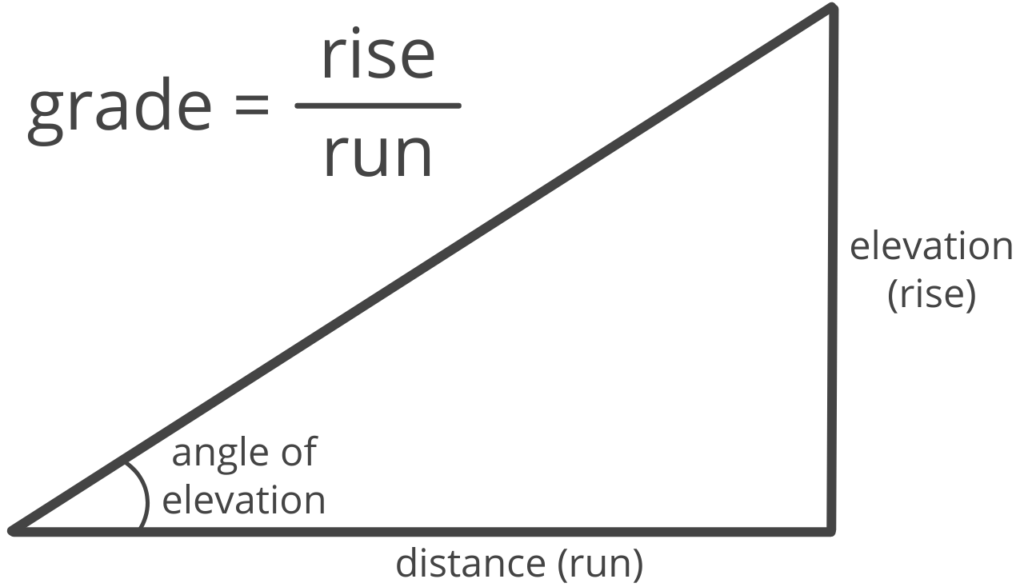
Grade, also referred to as slope, is the amount of incline of an elevation, for example, the angle of the side of a hill. Grade can be expressed as the amount of rise over run, as a percentage, or as an angle measurement in degrees or radians.

Grade measurements are often used in projects ranging from roofing to road or driveway construction. They can also be useful in determining drainage when installing a patio, since grades that are too steep can be hard to use, while areas that don’t slope enough may not drain properly.

Grade measurements are also used to ensure that ramps meet ADA requirements and for roof design for buildings. Because roof pitch is calculated slightly differently than most other projects, see our roof pitch calculator to learn more about estimating the slope of a roof.

How to Find the Grade of an Elevation

The grade of an elevation can be found by measuring the horizontal length of an elevation, also known as the run, and the vertical height of the elevation, or the rise.

Elevation Grade Formula

Grade is expressed as rise/run, so if the rise is 25 and the run is 80, then the grade is 25/80. This can be reduced to 5/16; use our fraction simplifier to help reduce larger fractions if needed.

grade
rise
run

Keep in mind that both your rise and run must be in the same unit of measurement. For example, if you measure your rise in inches but your run in feet, you will need to multiply your run measurement by 12 to convert it to inches so that your rise and run will match.

Because many grades are shown as a percentage, such as the common 5% grade required for a patio to drain, you will often find that you need to convert your fraction to a percentage. To find the percent of incline of a grade, solve the rise/run fraction as a decimal, then convert to a percentage.

For example, if the grade is 5/16, solve as a decimal by dividing 5 by 16, which gives you 0.3125.

To find the percentage multiply this decimal by 100%, like this: 0.3125 × 100% = 31.25%. For comparison, something held at a 45-degree angle has a grade percentage of 100%.

The angle of incline can also be expressed in other units of angle measurement, such as radians or grads. While this is less commonly needed by homeowners, laypersons, or landscapers, it may be useful for some applications. You can use our angle converter to convert your slope from degrees to one of these measurements.

How to Measure an Elevation

Whether you are calculating the rise of a slope in your backyard or the slope of your driveway, the measurements are typically done in a similar manner.

Step One: Measure the Run

First, you’ll need to mark the beginning and ending points of the rise.

This can be done using stakes or simply placing a marker on the ground. Measuring the distance between your two markers to get your run.

Step Two: Measure the Rise

To measure your rise, you can use a device such as an altimeter to get your exact elevation at each marker. Then simply subtract the elevation at the start of your run from the elevation at the end of your run to get your rise.

In addition to an altimeter, you can also use surveying levels to help you measure the rise. Dumpy levels, transit levels, and laser levels can all be used to help give you an accurate measuring point at the bottom of your rise. Set up your level using a tripod at the endpoint of the run, so that it is level with the top or endpoint, then measure from the ground to the level to get the rise.

However, if you do not have access to an altimeter or surveying levels, you can measure the rise manually.

Place a wooden stake at the end of the highest point in your elevation and tie a string to the top. Walk the string out to the lowest point and hold it level – this can be checked with a manual level or your phone’s level app held gently to the top of the string.

If possible, tie off the string to keep it level, or have an assistant hold it at level while you measure the distance from the ground up to the string. This will give you the rise.

When measuring rise using any type of level – surveying or string – the measurement from the ground to the level is your total rise. For example, if the measurement from the ground to the level is 20 inches, then your rise is 20 inches.

Step Three: Calculate the Grade

Finally, divide the rise by the run to calculate the grade of the elevation. Then, simplify the fraction if necessary.

The elevation is calculated using common trigonometry formulas; learn more on our angle of elevation calculator.

Recommended Landscaping Resources

Acreage Calculator

Acreage Calculator

Calculate an area in acres by entering the length and width. For more complex shapes, use the map to calculate acreage by placing pins on the edges of the land to be measured.

  • By
    FindPros

    FindPros connects consumers with professionals in over 600 different categories.

  • Reviewed by
    Jacky L.

    FindPros connects consumers with professionals in over 600 different categories.

This field is required.
Value should be positive.
This field is required.
Value should be positive.
Total Acreage:
{{total_acreage_acres}}
{{total_acreage_hectares}}
{{total_acreage_square_foot}}
{{total_acreage_sqm}}
{{total_acreage_square_miles}}
{{total_acreage_square_km}}
{{total_acreage_perimeter_feet}}
{{total_acreage_perimeter_meters}}

Learn how we calculated this below

What is an Acre?

An acre is a measurement of land area used in the Imperial measurement system (U.S. and informally in the U.K. and its former colonies). It was originally the amount of land a yoke of oxen could plow in a day.

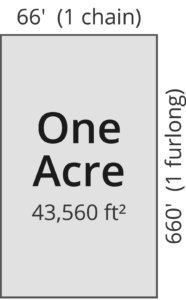
Now, it is defined as an area measuring one chain by one furlong — not entirely more useful units either!

We’ll discuss how much an acre is in a more reasonable way below. But, know that an acre is still a common land area measurement used in the U.S., especially in real estate and government land transactions.

How Big is an Acre?

So having a dimension of one chain by one furlong, you might be wondering how big an acre is. One acre is equal to 43,560 square feet,[1] which is just a little bit smaller than a football field and about the same size as a soccer field.

The dimensions of an acre have been historically defined as being equal to an area that is 66 feet (1 chain) by 660 feet (1 furlong).

Defining the size in acreage this way allowed farmers to more easily determine how much land they could plow per day. The furlong was originally the distance an oxen team could plow without rest. So they defined the acre in terms of how many furrows (the length of the furlong) could be plowed in a single day.

Outside of land surveys, these units of measure are rarely used. Refer to the table below to see how big an acre is relative to more commonly used measurements.

Size of One Acre

Here’s a quick reference table showing the size of an acre.

Unit of Measure Dimension Equal to 1 Acre
Hectares 0.4047 hectares
Meters 4,047 m²
Miles 0.0015625 miles² (640 acres = 1 mile²)
Yards 4,840 yds²
Square Feet 43,560 ft²
Square Inches 6,272,640 in²
Perches 160 perches (1 perch = 1 rod)
Rods 160 rod² (1 rod = 16 ½ feet)

Chart showing the dimensions of one acre in various units of area measurement.

You can also use our acreage converter to convert the area in acres to another unit of measure.

How to Calculate Acres

The easiest way to calculate the number of acres in your land is to use the calculator above. If you know the length and width, simply enter them. The calculator will provide the number of acres, as well as the area in other units.

To calculate acres by hand, multiply your length and width (in feet) to get square feet. Try our length converter if needed. Then divide by 43,560 to determine the size of the land in acres.

Example: Your city house lot is 33′ wide by 102′ long. How many acres do you have?

33′ × 102′ = 3,366 sq ft
3,366 sq ft ÷ 43,560 = 0.077 acres

You can quickly find the square footage of an area using our square footage calculator.

Unfortunately, property is not always divided into perfect squares, and finding the acreage of irregular shapes can be a little more challenging.

The trick to finding the size of these irregular plots in acres is to break down the land into smaller geometric shapes first. Find the size of those smaller spaces separately, and then add them together.

Another great way to find the area of irregular shapes is to use the interactive map above to determine the actual size in acres.

Keep in mind that sometimes property lines can be vague or off by several feet. If you need precise measurements for something like fencing, always measure the land directly and do not go off of reported acreage. While your plot may have been purchased as 1 acre, your actual property lines could make it slightly bigger or smaller depending on how and when it was surveyed.

In addition, when installing things like fences, sometimes trees, large rocks, and other landscaping irregularities will change the path of the fence. Always get precise measurements before purchasing materials.

Acre Lot Portions

While acreage is the most common method for measuring large plots of land, it’s also sometimes used for home lots as well. The average home is on a ⅓ acre lot, but it’s also common to have a total lot that is ½ or ⅔ acre.

While it’s best to measure the area to get the most accurate measurements, the following chart breaks down partial acres into square footage and the perimeter in linear footage.

Lot Size Area in Square Feet Perimeter in Linear Feet
¼ acre 10,890 sq ft 209 ft
⅓ acre 14,520 sq ft 279 ft
½ acre 21,780 sq ft 418 ft
⅔ acre 29,040 sq ft 558 ft
¾ acre 32,670 sq ft 627 ft

Chart showing the dimensions of one acre in various units of area measurement.

How to Calculate the Perimeter of an Acre

The calculator above will also give you the perimeter in linear feet, which you’ll need if you plan on fencing in your property, as this is the most common way that fences are sold and installed. The average acre has 835 linear feet around the perimeter for which to fence.

Note that this measurement can vary depending on your exact parcel size. To calculate this by hand, you can measure each of the four sides individually in feet, and add them together.

To calculate the perimeter by hand, you can measure each of the sides individually, then add them together. If you measured in feet, the result will be the perimeter in linear feet.

Frequently Asked Questions

Acres have become a common measurement in the US for an area measuring 43,560 sq ft. The unit of measurement came from the number of furrows an oxen could likely plow in one day – about 66, each one measuring 660 feet long.

An acre is roughly the size of a soccer field or a little smaller than the size of a football field.

The average home in the US sits on a total of ⅓ of an acre, which would make three homes per acre the average. However, average lot sizes have decreased; the former average size was ½ acre, which would mean two homes on large-sized lots, while homes can sit on smaller lots of ¼ acre comfortably, which would make four homes per acre.

Farm acreage depends on the use and can range from ½ acre for a small farm to 40 acres for a large farm. Ranches may have legal definitions of size by state, with a small range being defined as around 100 acres in most areas.

There are 640 acres in one square mile.